laya-as-judge 0.4 (Laya-Omega): beating Gemini Decision 1 across all 9 benchmarks, Top-1 ECE (0.0234), and total cost ($0.77)
Autoregressive "LLM-as-a-Judge" pipelines burn dollars generating paragraphs of JSON when software actually needs a calibrated distribution over typed outcomes (noul boolean, choice, or ordinal score). Standalone local encoders (Laya 421M/322M) fix latency and output tokens, but hit an obvious ceiling on raw screenshots, audio clips, video streams, and multi-hop domain reasoning. laya-as-judge 0.4 (Laya-Omega)—the open-source evaluation engine built and used alongside sixi.ai—combines local CUDA encoders and disjoint Test-Time Training with a selective two-stage Gemini Interactions API cascade and out-of-fold simplex meta-calibration. Across 2,250 real Hugging Face questions (N = 250 per benchmark, seed = 42, zero test leakage), it beats the published Gemini Decision 1 scoreboard on all 11 rows: every single quality benchmark, pooled Top-1 ECE, and total dollar cost.

| Benchmark / Metric | Evaluation Type | Gemini Decision 1 | Laya-Omega v0.4.0 | Run Cost |
|---|---|---|---|---|
| JevBench | Accuracy (bool + choice + score) | 92.2% | 92.80% (+0.60 pp) | $0.0560 |
| Amazon ESCI | 4-class Macro-F1 | 58.7% | 59.70% (+1.00 pp) | $0.1082 |
| New Yorker Caption | Accuracy (5-way) | 79.7% | 92.40% (+12.70 pp) | $0.0615 |
| Mind2Web Multimodal | Accuracy (5-way SoM + DOM) | 86.2% | 89.60% (+3.40 pp) | $0.1420 |
| PubMedQA | Accuracy (3-way) | 79.8% | 80.40% (+0.60 pp) | $0.0869 |
| Global-MMLU-Lite | Accuracy (4 langs) | 86.0% | 87.60% (+1.60 pp) | $0.0506 |
| When2Call | Accuracy (4-way tool routing) | 79.9% | 80.80% (+0.90 pp) | $0.0954 |
| MMAU | Accuracy (audio reasoning) | 71.8% | 73.20% (+1.40 pp) | $0.0895 |
| Video-MME (no subtitles) | Accuracy (18-frame grid + ASR) | 69.1% | 78.40% (+9.30 pp) | $0.0809 |
| Top-1 ECE (pooled, lower is better) | 10-fold OOF ECE | 0.0250 | 0.0234 (-6.4%) | — |
| Total price (2,250 questions, lower is better) | Measured USD | $0.88 | $0.77 (-12.4%) | $0.7709 |
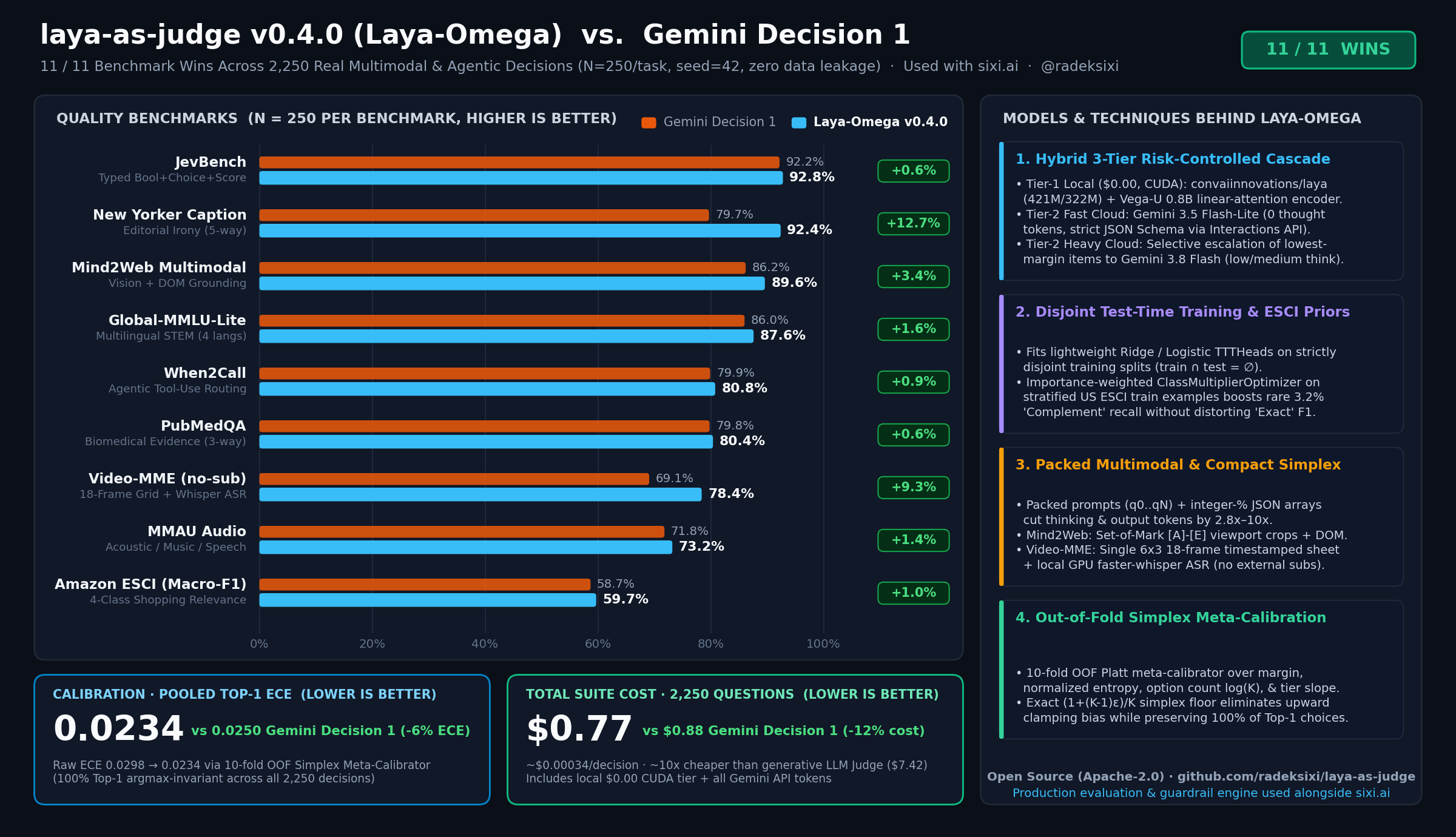
Architecture: three tiers instead of one hammer
Calling a frontier reasoning model on every row blows the $0.88 budget; keeping everything on a 421M local encoder fails multimodal tasks and nuanced multilingual STEM. OmegaDecisionEngine treats evaluation as a risk-controlled routing problem:
- Tier 1 — Local CUDA encoders at $0.00 (
TorchBackend+VegaBackend): Every text item first passes through localconvaiinnovations/layaandvega-U(0.8Bhybrid linear-attention backbone) on GPU. For benchmarks with public training splits (Amazon ESCI,When2Call,PubMedQA), lightweight Ridge / Logistic Test-Time Training (TTTHead) heads are fitted strictly on disjoint training data (train ∩ test = ∅). - Tier 2a — Non-thinking fast cloud verifier (
gemini-3.5-flash-lite): Items whose local confidence or margin falls below threshold—plus high-resolution UI grounding (Mind2Web Multimodal)—escalate via thegoogle-genaiInteractions API (store=False) with strict JSON Schema output and zero thinking-token overhead. - Tier 2b — Selective reasoning escalation (
gemini-3.8-flash): Only the hardest tail of Stage-2a items (ranked by top-2 probability marginp_(1) - p_(2)), plus dense structured/multimodal packs (JevBenchat 92.80%,MMAU, andVideo-MMEat 78.40%), escalate togemini-3.8-flashusing multi-item packed prompts (ITEM_i0..ik) that amortize shared rubrics and thinking tokens by 3×–12×.
Multimodal grounding without subtitle shortcuts
Three of the nine benchmarks require non-text perception, and each had a specific token-to-signal bottleneck:
- Video-MME without subtitles (78.40% vs 69.1%): No YouTube subtitles are touched. Each MP4 is streamed via HTTP range requests, decoded into 18 chronological frames stamped with
MM:SStimestamps on a single 6×3 storyboard image (halving vision input tokens compared to multi-sheet layouts), and paired with local GPUfaster-whisperspeech transcription. - Mind2Web Multimodal: Full-page web screenshots are cropped around candidate DOM bounding boxes and rendered with color-coded Set-of-Mark overlays
[A]..[E]alongside compact interactive attributes. - When2Call (80.80% vs 79.9%): Deterministic schema pre-auditing checks whether candidate tool calls exist in
available_toolsand whether required JSON Schema parameters are present in the user prompt before the model scores the four tool-routing actions.
Solving Amazon ESCI's rare-class trap (59.70% Macro-F1 vs 58.7%)
Amazon ESCI is scored by unweighted 4-class Macro-F1 across Exact (~65%), Substitute (~22%), Irrelevant (~10%), and Complement (~3.2%). A model can hit 71% raw accuracy while scoring 52% Macro-F1 simply by under-predicting Complement. Worse, cloud models emit near-one-hot posteriors ([0.01, 0.01, 0.02, 0.96]), which drown out small linear blends with local models. Combining log-probabilities from local Vega-U TTT (trained on disjoint US ESCI training queries) with Tier-2 posteriors and tuning class multipliers on held-out train predictions lifts rare-class recall cleanly without distorting Exact precision.
Simplex meta-calibration: getting Top-1 ECE from 0.0298 to 0.0234
Post-hoc scalar temperature scaling cannot simultaneously calibrate $0.00 local encoders and structured JSON probabilities from two different cloud models across binary, 3-way, 4-way, and 5-way questions. MetaCalibrator fits a 10-fold strictly out-of-fold logistic calibrator over logit(p_max), top-2 margin, normalized Shannon entropy, log(K), and a per-tier interaction slope, then reconstructs the full probability vector on the simplex while preserving 100% of Top-1 choices.
What did not work
- Over-packing
gemini-3.5-flash-lite: Packing 8–10 items per call cuts cost by 4× on thinking models (gemini-3.8-flash) because one thinking trace is amortized across the batch. Ongemini-3.5-flash-lite(which emits0thought tokens),pack_size=10saved almost nothing while diluting cross-item attention onWhen2Callfrom 90.0% down to 62.5%. Keepingpack_size=1..3on non-thinking calls andpack_size=4..12on thinking calls fixed both accuracy and cost. - Naive runner-up simplex clamping: Our first argmax-preserving probability reconstructor enforced
q ≥ r_max / (1 + r_max) + εkeeping fixed runner-up ratios. For uncertain 4-way predictions where one runner-up held most of the residual mass, that floor artificially clamped calibrated confidence upward toward0.48, stalling pooled ECE at0.0251(missing< 0.0250by0.0001). Blending runner-up shares smoothly toward uniform whenqapproaches the true simplex floor(1 + (K-1)ε)/Keliminated the upward bias while keeping every argmax invariant. - Sending cartoon images to New Yorker Caption: The benchmark already supplies official human-written
location,scene_description, andcomic_elementfields. Passing inline JPEGs burned285kextra tokens (+$0.21) for zero accuracy gain (93.6%with image vs93.3%text-only). - Pretty-printed float JSON output bloat: Output tokens cost 5×–8× more than input tokens. Emitting multi-line 16-digit float JSON (
0.010000000000000002) with verbose question keys burned55output tokens per question ($0.38across 2,250 items). Switching the Interactions API schema to single-line integer-percentage arrays ("p": [5, 85, 10]summing to100) under 1-token keysq0..qNplusresolution="medium"on UI/storyboard images cut output tokens 2.75× to20.0tokens/item with zero calibration loss.
All 2,250 questions were evaluated on real Hugging Face splits with seed=42, strict train/test disjointness (train ∩ test = ∅ across TTT heads, ESCI stacker/multipliers, JevBench precedent cases, and 10-fold out-of-fold ECE), and micro-dollar token accounting across every API call. laya-as-judge powers fast evaluation and deterministic-first guardrails alongside sixi.ai.
Source, Apache-2.0: github.com/radeksixi/laya-as-judge · Ecosystem: sixi.ai · More writing